1. The Philosophy of Auto-Selection: Content as a Strategic Filter
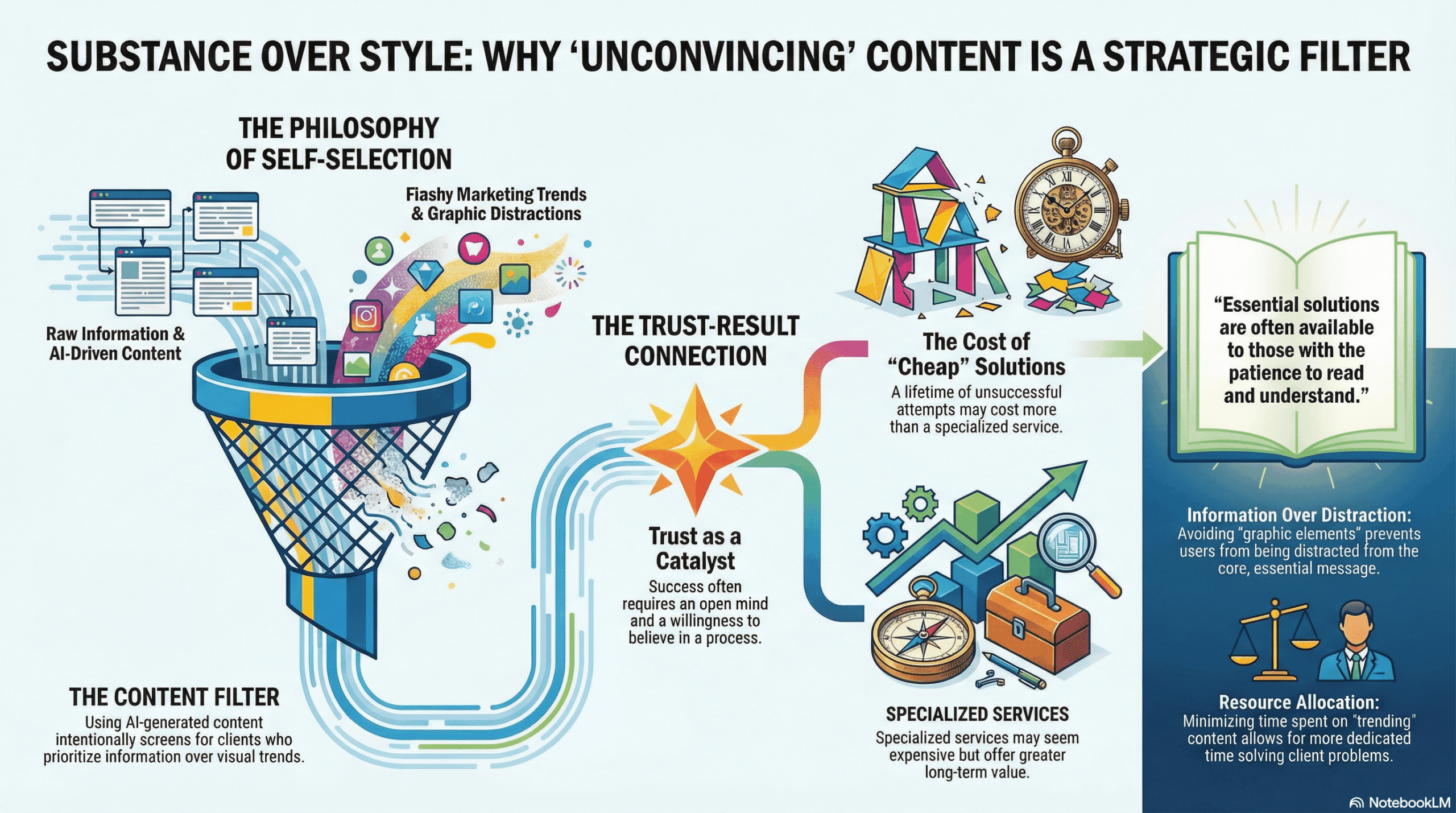
In the high-stakes landscape of professional services, content is frequently mismanaged as a tool for mere engagement. A more sophisticated strategic approach utilizes content as an intentional friction point—a high-level filtering mechanism. By prioritizing raw, information-dense material over trending aesthetics, and specifically deploying AI-generated assets via Google NotebookLM, a provider executes a “diagnostic test” of the client’s cognitive patience. This strategy effectively camouflages the solution, ensuring it is only accessible to those who value functional depth over superficial presentation.
The strategic rationale for prioritizing information density over graphic polish is the optimization of organizational resource allocation. By utilizing an AI-driven aesthetic that many would deem “unconvincing,” the provider creates a barrier that serves as a pre-qualification phase. This filter achieves the following:
- Pre-emptive Elimination of Cognitive Overhead: It prevents the exhaustion of resources on “unready” clients. If a prospect requires a curated, high-gloss presentation to engage, they lack the capacity to comprehend the complex, non-linear processes required for a successful outcome.
- Optimization of Internal Momentum: By bypassing the need to explain the “how” to skeptical audiences, the provider protects the time necessary to deliver results for high-intent clients.
- Validation of Client Intellect: The content serves as a mechanism to identify users capable of synthesizing raw data and looking beyond the “AI” label to extract actual value.
This external diagnostic of cognitive capacity acts as the primary gatekeeper, transitioning the prospective client from a state of passive consumption to one of active, internal commitment.

2. The Desperation Paradox: From Skepticism to Radical Trust
The critical inflection point in the client decision-making process often occurs during a “moment of desperation.” When traditional, high-cost options have been exhausted, the resulting psychological fatigue creates a tactical opening for unconventional solutions. This “dead end” forces a recalibration of risk, where the fear of the unknown is finally outweighed by the certainty of current failure.
The transition from classifying a service as a potential “scam” to experiencing a validated outcome requires a radical shift in perspective. The client moves from an analytical stance—fearing a “psychological marketing method”—to an outcome-based validation that renders previous skepticism irrelevant.
The Transition of Perspective
| Initial Client Fear / Classification | Eventual Realization / Outcome-Based Validation |
| “Classified as a scam with a psychological marketing method.” | Recognition of a functional, high-value technical solution. |
| Loss of Capital (“A few thousand euros”) | Minimal investment compared to the “fortune” spent on failed traditional alternatives. |
| Aesthetic Skepticism (AI-Generated Content) | Realization that information density is the only metric that correlates with results. |
| Instinctive Resistance (“No”) | Acknowledgment that the leap of trust was the bridge to the solution. |
This willingness to “give it a chance” is a strategic necessity; it is the moment the client accepts that they must believe in a process they do not currently have the technical or cognitive capacity to dissect.

3. Hidden in Plain Sight: The Information vs. Distraction Conflict
A primary barrier to resolution is the “magic pill” mentality. Most consumers suffer from a chronic blindness, failing to recognize transformative information because it lacks the charismatic deception of trending media. While the provider “hides” every requirement for success in plain sight within the unpolished data, the average user is too busy waiting for the “devil’s magic solution.”
The provider strategically exploits this consumer blindness to dissect the market. Most people lack the discipline to listen, read, and understand, choosing instead to wait for a “magic pill” delivered via high-gloss distraction. By refusing to cater to this desire for graphic stimulation, the provider ensures that the internal merit of the client must emerge. The solution is not camouflaged by complexity, but by the client’s own lack of patience.
4. The Core Catalyst: The Strategic Necessity of Belief and Positive Mindset
In complex problem-solving, “Belief” is not a theological construct; it is a functional requirement. Skepticism and instinctive fear act as mechanical barriers to the execution of a process. The provider’s assertion that “the merit is entirely yours [the client’s]” is a clinical observation of behavioral compliance.
Success requires the client to perform an extraordinary behavioral feat: the voluntary suspension of cynicism. The merit lies in the client’s ability to follow expert advice without the constant interference of a fear-based “No” reaction. The three psychological requirements for this success are:
- Radical Open-mindedness: Entertaining solutions that contradict previous failed paradigms.
- Trusting the Process: Relinquishing the need to understand every technical mechanism before proceeding.
- Suppression of Instinctive Friction: Resisting the natural urge to reject unconventional methods due to fear or a lack of aesthetic polish.
This psychological alignment is the fundamental catalyst that converts the provider’s technical advice into a tangible economic and personal recovery.
5. Economic Realignment: Assessing the True Value of Results
A strategic assessment of value requires moving beyond the immediate price tag to calculate the Net Economic Recovery. While a specialized service may appear “expensive at first glance” (commanding a fee of “a few thousand euros”), it is a fraction of the “fortune” lost to the aggregate cost of previous failures.
Value Assessment: Total Cost of Failure vs. Investment in Success
- Total Cost of Failure: The “fortune” already spent elsewhere—comprised of high-cost traditional fees, lost time, and the compounding debt of an unresolved crisis.
- Investment in Success: A targeted expenditure that, while appearing high in isolation, results in a marginally lower cost when compared to the history of unsuccessful expenditures.
The ultimate competitive advantage is the ability to recognize that a successful outcome, regardless of the initial fee, is the only path to halting further resource drain.
6. Conclusion: The Strategic Path Forward
When traditional avenues have reached a dead end, the only remaining bridge to a solution is the disciplined choice to believe. As this analysis confirms, the path to resolution is often obscured by a deliberate filter of information density and the requirement for radical trust in a “stranger.”
Apex Med Insights remains a high-level resource for those whose eyes have been opened to these possibilities. While success cannot be guaranteed for all, it is strategically impossible for those who cannot move past instinctive skepticism. For the few who can see beyond the surface, the opportunity to resolve the impossible remains.