I want to talk about something that sounds completely absurd at first. Counter-intuitive. Almost offensive to some.
People prefer pain. Any form of it. No matter how strong, how long, how destructive. They prefer it over happiness.
I see this every single day in my work. For years. And the more I look, the clearer it becomes.
Most people will tell you they don’t choose the pain. “That’s just how life is.” “It just happens.” “I can’t help it.”
Bullshit.
What actually happens is this: continuous pain, discomfort, sadness, drama — they give a type of pleasure that requires zero real effort. Happiness, real happiness, demands constant work. Regulation. Choice. Responsibility. Showing up differently even when the old pattern is screaming.
Pleasure and happiness are not the same thing. You can have intense pleasure while being deeply unhappy. You can feel a chemical high from amplifying your own suffering.
You know that moment when you’re heartbroken and you put on the exact song that makes the pain a hundred times worse? Logically you should stop it. But you don’t. You play it again. And again. Because in that moment the intensity feels like something. It feels alive. It gives a hit. Your brain is getting a reward from the suffering itself.
That’s the mechanism most people never look at.
The man with the allergy
There’s a guy who comes to me every year with the same allergy problem. Every spring it’s worse. The treatments he keeps doing cost more and more and work less and less.
At the beginning I tried to help. Then I stopped. Why? Because he doesn’t actually want to get better. The situation gives him something: a legitimate reason to complain every single spring. A role. Attention. A story.
When I told him this directly, he got angry. Said it’s not true. I answered:
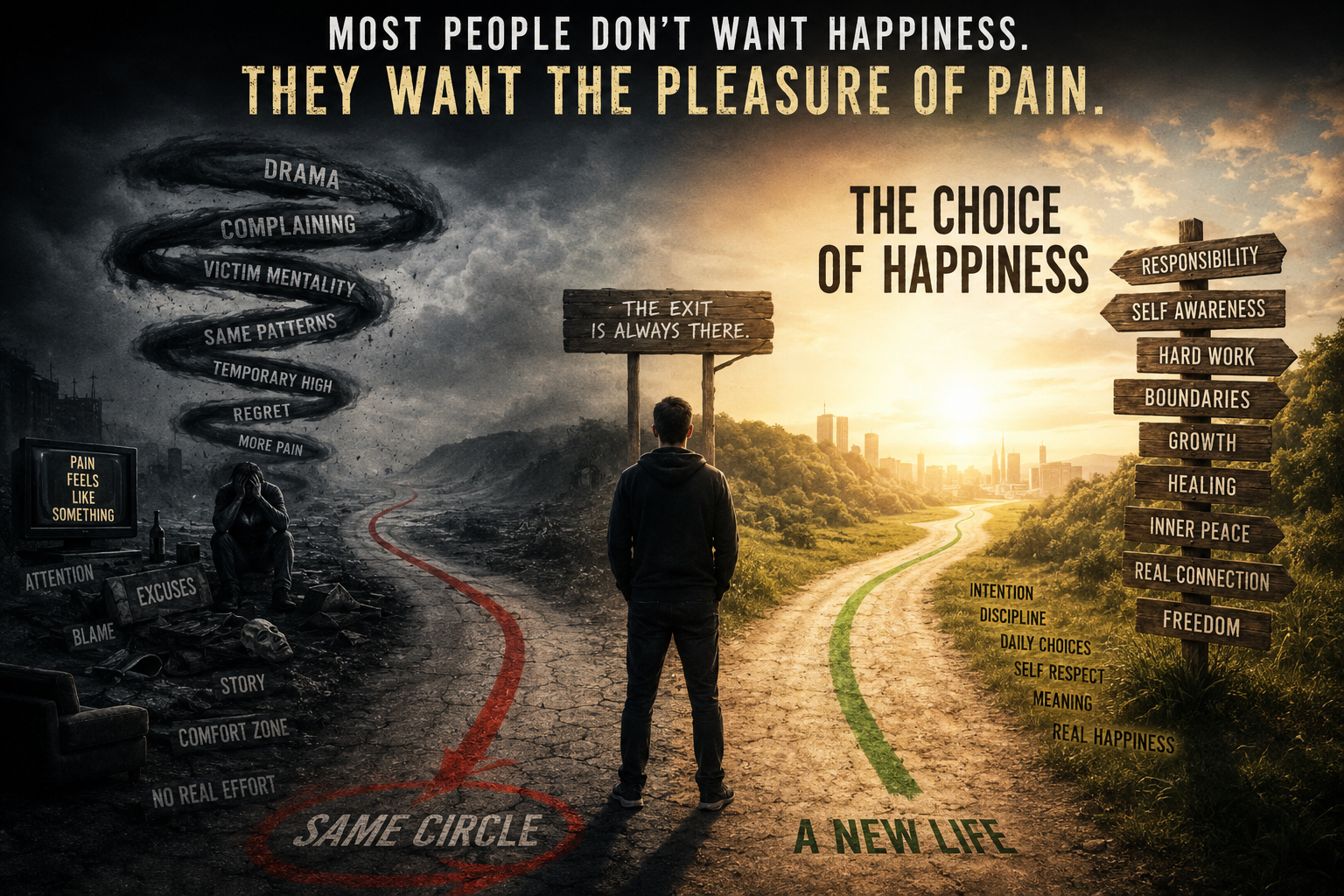
“Okay. We know each other well. You don’t have to trust me. But use simple logic. If something you’ve been doing for years keeps getting worse and more expensive, why the hell would you keep doing the exact same thing? There’s a clear exit. A cheaper, non-invasive option. Yet you keep walking in the same circle, complaining that you can’t get out, while the red line pointing to the exit is right there on the floor.”
He still does the same thing every year. Because staying in the pain and complaining about it feels better to him than the effort of changing.
The 30-year-old woman
Two years in a relationship. Same pattern I saw in all her previous ones.
Two weeks of real happiness. Not fake. You can see it in her face, her body, her reactions. She’s light. Present. Alive.
Then, like clockwork, she flips. Becomes unbearable. Blames everyone. Impossible to have a normal conversation with.
I’ve talked to her about this many times. I told her: “I think you’re addicted to sadness. You need a shitty life, otherwise I can’t explain this.”
I went further. A few times I filmed her in both states. When I showed her the videos, she didn’t even recognize herself.
Sometimes she understands. She says “What do you want me to do?” I answer: “Choose to be happy. Drop that insane need for pleasure that comes from making your own life and everyone else’s impossible.”
One day she said something honest:
“Maybe I believe I don’t deserve happiness and I create the pain myself. Plus… when I fight with my boyfriend we have a reason to make up. And we all know what happens after. Madness. Maximum fun. Maybe I need the pain as a reference so I can appreciate the happiness. I have to experience the suffering again and again first.”
She was right. That’s exactly how the trap works for many people. The conflict-reconciliation cycle gives a massive dopamine spike. Calm, stable happiness feels boring in comparison. So the system keeps manufacturing the drama.
The other side
I know another woman, 40+. It took her five years to get out. I was next to her for eight.
She wanted it. She showed real intention. It was a lot of work. Ugly at times.
Now she tells me:
“I don’t know how the fuck people choose to be sad and unhappy all the time. The world looks different now. Like I’m living in another place. Yes, it’s more work. But I feel so much better than when I was sad and miserable constantly. My social life is a thousand times better.
I still get the old pull sometimes. Then I catch myself and say: ‘I can choose. I choose to be happy.’”
That’s the difference. One still feeds on the pleasure of pain. The other decided the price was too high and kept choosing, day after day, until the new path became stronger.
My rule now
I try once. Sometimes twice. Then I step back and say: “You’re right.”
Because I have a simple principle: If you don’t want to raise your hand, I cannot raise it for you.
In the beginning I used to feel bad for people. I kept trying and trying. Now, the moment I see real resistance, I stop. I refuse to pour time and energy into someone who doesn’t want it. I’d rather give everything to the person who shows intention — even if it takes years and a mountain of work.
Those who want to get out, or who at least show they’re willing to try, I respect them deeply. I’ll walk with them the whole way.
The ones who don’t? I’m done.
This isn’t cruelty. It’s clarity.
Most people are not stuck because they can’t change. They’re stuck because the pain is giving them something they’re not ready to give up. A cheap, effortless form of pleasure. An identity. A story. A reason.
Happiness requires you to take full responsibility. That’s why so many reject it.
The exit is always there. The red line is drawn on the floor.
Some people will keep walking in circles and call it life. Others will eventually stop, look at the line, and decide to walk out.
I’ve seen both. I know which ones are worth my time.