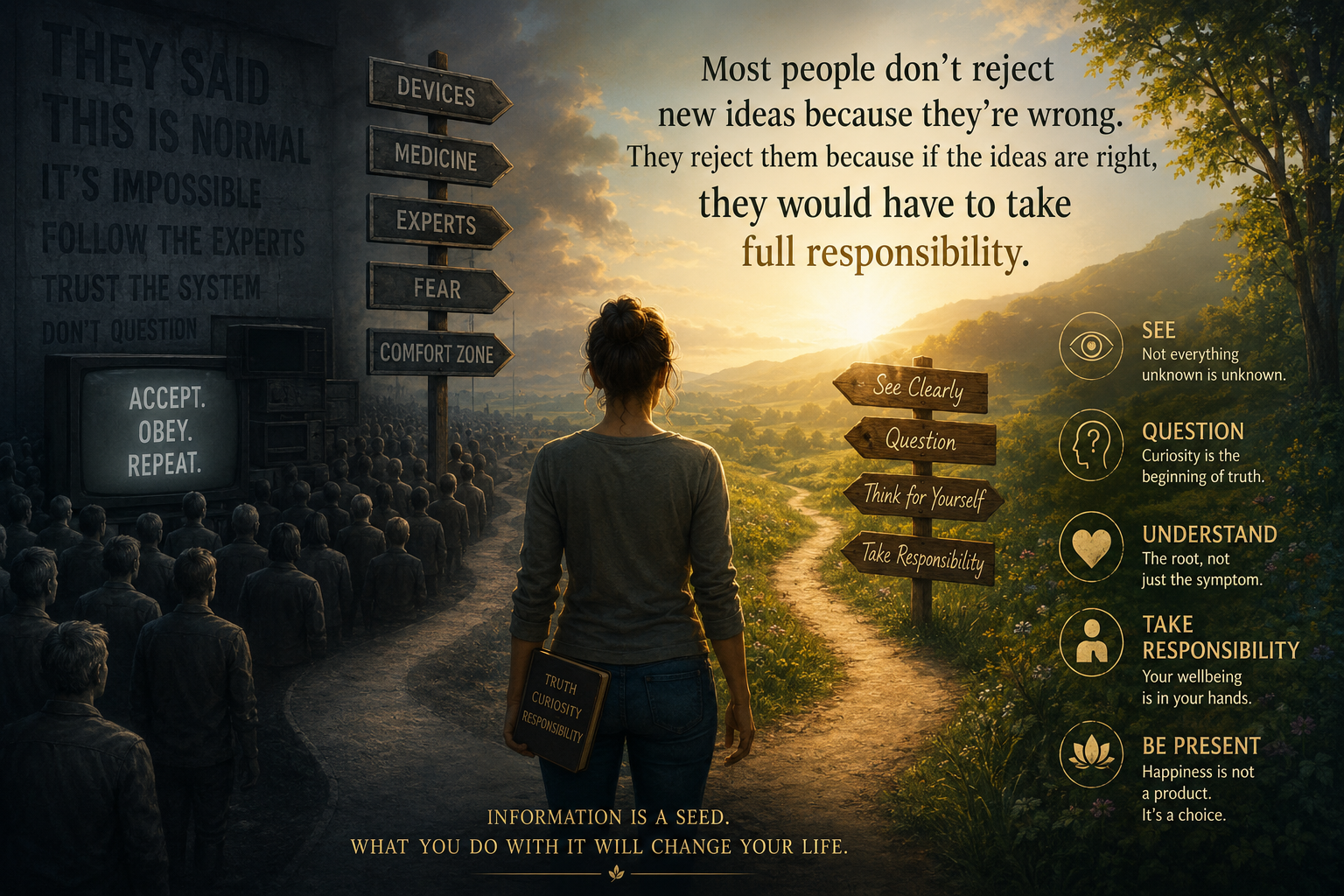
They reject them because if the ideas are right, they would have to take full responsibility.
I keep noticing the same thing over and over.
For thousands of years humanity lived, functioned, and evolved without devices, without this medicine, without that specialist, without some guru telling them how to live. Then somehow we arrived at a point where people believe they cannot live without device X, without medicine Y, without the advice of some expert who is often just very good at marketing.
Somewhere along the way we lost something important: the ability to truly see, to understand, to stay curious, and the willingness to face what we call “the unknown” — which is often not unknown at all, just what we have forgotten.
A few days ago I had a conversation with a new client. She found me out of pure curiosity. Not because she believed in what I do. Not because she trusted me. Just curiosity.
At the first meeting she didn’t even plan to become a client. She just wanted to hear what I had to say. She was testing. We spoke two different times. She told me later that even though some of the things I said seemed hard to believe, almost impossible, they still had logic. Real logic. Not stories I heard from someone else.
Because she still had a minimum of knowledge in the domain and she used her intellect instead of immediately rejecting everything, she could see that somewhere there was truth. So she decided to try, especially the things that everyone else had told her were impossible… “it’s normal at your age”, “nothing can be done about that”.
About a month later she came back and said something that stayed with me:
“You know, I thought the whole thing was a complete scam. I didn’t believe any of it. But then I surprised myself. I saw visible results where everyone told me it was impossible. Instead of the hundreds of euros that were recommended to me before (and didn’t work), something that costs the price of a coffee worked. But it’s not about the price. It’s about understanding where the real problem is and solving the root, not just the symptom.”
Then she continued:
“Even though I tested it, even though the results are clear and visible, it’s still hard for me to fully accept it. Not because I’m closed-minded. But because for generations everyone has said: do this, do that, this is impossible, that is good (when it’s actually bad). These habits and beliefs are passed down. And then you come along, with no certificate, no diploma, and you say almost everything is wrong. Do you realize how that sounds? No matter how open-minded a person is, it’s extremely hard to accept something that goes against what you’ve been told your entire life. And the strangest part is… this nobody is right. It works. But the brain still struggles to process it.”
She is right.
Even when the evidence is in front of your eyes, changing deep habits that were recommended by family, society, and specialists is not easy. It’s like being told that the morning coffee and breakfast on the terrace with friends — something everyone considers normal and healthy — is actually one of the things slowly killing you. Even with clear proof, most people will find it almost impossible to accept and change.
This client is rare. One in a thousand, if I’m being generous.
Most people don’t even listen. They reject immediately. Someone once explained it to me in a way that made complete sense:
If a person allows themselves to truly listen and understand, the information stays. A seed remains. And that seed will eventually force them to question everything they thought they knew. It will force them to take responsibility — to admit that part (or a lot) of what they believed was wrong, and that their wellbeing depends mostly on them.
And almost nobody wants that.
It’s easier to stay sick and ignorant than to get better and carry full responsibility.
When I meet people who are the opposite of this client — people who already have their defenses up — I try once. Sometimes twice. When I see strong resistance, I take a step back and simply say: “You’re right.”
There’s no point fighting windmills.
One more thing I do differently: I almost never wish people “health” anymore. I wish them to be happy.
Most people are surprised. They look at me like I said something strange. Because for them happiness means having something — money, status, a relationship, things. They treat happiness like a product you can acquire.
But real happiness cannot be bought. You have to be present in the moment to actually live it. Health, on the other hand, can often be influenced or “bought” to a certain degree. You can buy something that removes the pain, at least temporarily. Happiness doesn’t work that way.
You either live it now, or you don’t.
I think the deepest problem is not that people lack information.
It’s that most of them are terrified of what the information would require from them if they actually accepted it.
What do you think?