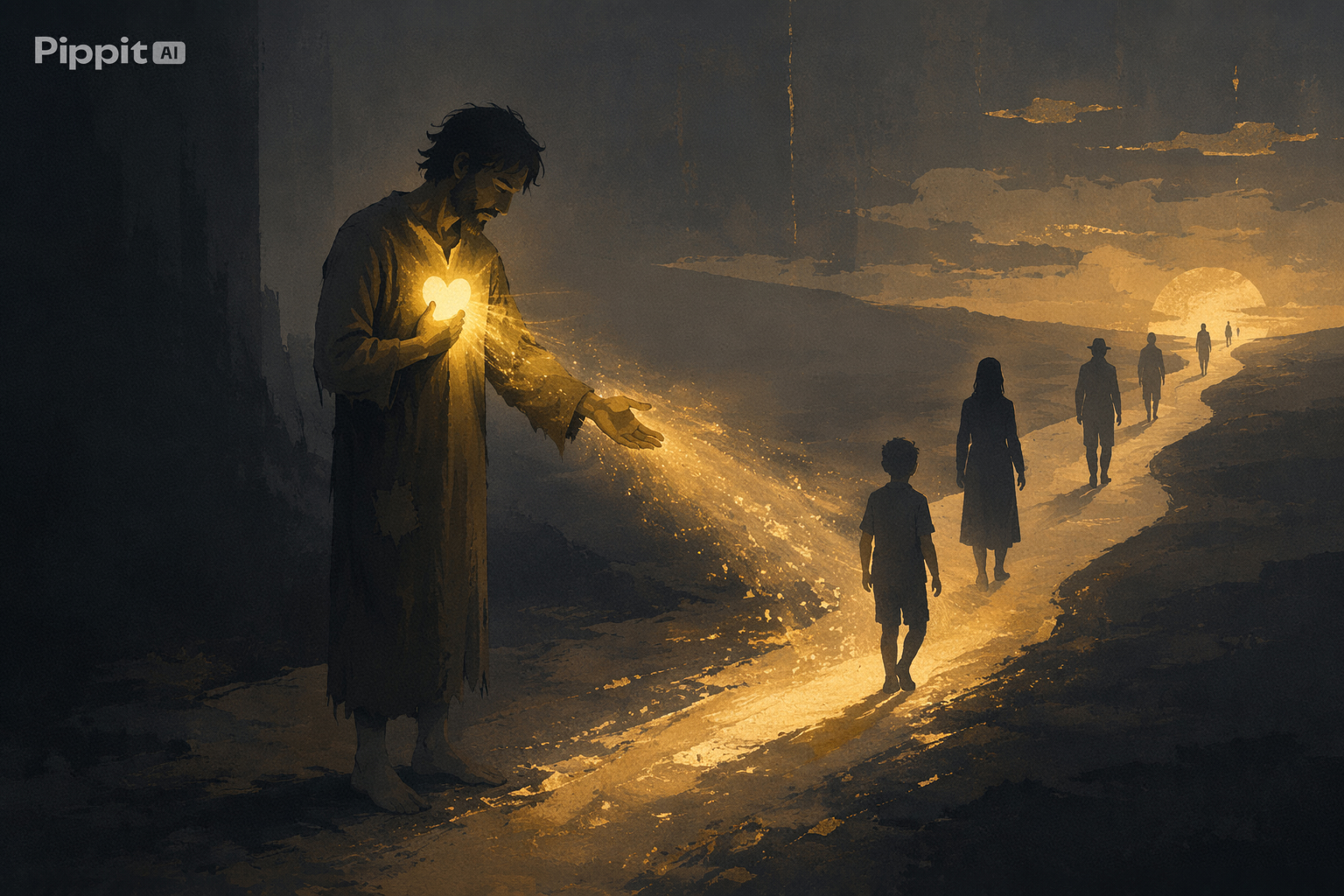
There is a persistent, quiet mystery in the landscape of human behavior: the people who give the most to society are often the very ones who refuse help when they need it most. We tend to view generosity as a surplus—an overflow from a full cup. But for a specific subset of people, kindness isn’t a byproduct of having too much; it is a fundamental choice made even when they have nothing at all.
This reveals a profound truth about the nature of giving. Real generosity is not measured by the volume of what is handed over, but by the weight of what is left behind. When someone gives from their last reserves, they aren’t just sharing a resource; they are offering a piece of their survival. This is “invisible generosity”—the kind that doesn’t make it into annual reports but sustains the very fabric of our communities.
Understanding this dynamic requires us to deconstruct our modern definitions of kindness and trust. In a world that has been trained to be suspicious of any gesture without a price tag, genuine generosity has become a confusing, and sometimes even threatening, outlier. By examining the mechanics of sacrifice, we can begin to see why those who are the easiest to rely on are often the hardest to reach, and how we might finally bridge that gap.
1. Real Generosity is Math, Not Just a Number
We often mistake the size of a gift for the scale of the generosity. However, true generosity is a matter of proportion rather than absolute value. Consider a man who asks for €500. His girlfriend immediately transfers the full amount from her balance of €5,000. His best friend transfers €274.47—every single cent in his account.
Most observers stop thinking the moment they see the numbers. They conclude the girlfriend gave more because €500 is numerically superior to €274.47. But the “Math of Sacrifice” tells a different story:
- The Low-Impact Gift: The girlfriend gave 10% of her wealth. It is kindness without discomfort.
- The Total Sacrifice: The friend gave 100%. The impact is total; he is left with nothing.
“Real generosity isn’t about the amount. It’s about the sacrifice.”
This leads to an uncomfortable follow-up question that exposes the tension between logic and goodness: Would the girlfriend have still given that money if €274.47 was all she had? We often overlook the “Best Friend” in society because we are blinded by absolute values. We have been conditioned to favor the surplus over the sacrifice, missing the rare goodness of those who give everything simply because a need exists.

2. The “Lottery Test” and the Trap of Theoretical Kindness
There is a psychological chasm between being generous with things we don’t have and being generous with what is currently in our hands. This is the “Lottery Test.” It is easy to promise to give away half of a million-dollar win that doesn’t exist yet; it is significantly harder to give away two eggs when they are the only food in your kitchen.
Theoretical generosity is a “someday” promise. It allows people to feel like “good persons” based on hypothetical future success. This “theoretical kindness” is a trap; it costs nothing and changes nothing. True character is tested by immediate, tangible sacrifice. The truly selfless do not wait for a surplus to act; they act from their current reality, however meager it may be. They understand that a real gift is only real if it costs you something in the now.
3. When “Free” Becomes a Red Flag
In an experiment involving “The One Protocol“—a health recovery system designed to improve health by 50% within 12 months at zero cost—nearly 40% of the target audience immediately rejected the help. This resistance reveals a tragic reality: for those who have spent their lives giving everything while having nothing, “free” help is viewed as a scam.
For “The Proud Ones,” suspicion is not a personality trait; it is a survival mechanism. A lifetime of transactional relationships has trained them to look for the “angle.” They have learned that every “gift” eventually comes with a hidden debt, an obligation, or a catch. Their experience has taught them that no one gives them anything for free, so they stop trusting the hand that offers a way out.
The responses to genuine, free help generally fall into three categories:
- The Proud (40%): They reject help immediately. Their internal dialogue says, “I don’t take charity” or “Everyone has an angle.”
- The Conditionally Open (30%): They require significant time, relationship-building, and repeated evidence of consistency before moving from “too good to be true” to acceptance.
- The Immediately Open (30%): Those who either have maintained an rare ability to trust or are desperate enough to bypass their survival filters.
The tragedy is that the people who have been let down the most by systems are the least likely to trust an individual offering a genuine solution.
4. We Have Been Trained to Trust Credentials Over Character
Modern society has conditioned us to prioritize institutional trust over human connection. We have reached a point where we trust the degree more than the person, and the price tag more than the results.
Group A: The Institutional Trusters These individuals have been trained to trust only systems and official channels. They ask:
- “What are your qualifications and where did you study?”
- “Which institution certified you, and can I see your degrees?”
- “What medications or supplements will I need to buy?”
When the answer to the last question is “none,” Group A often walks away, convinced it’s a scam because “nothing valuable is free.” They will willingly pay $500 for a failing “certified” solution while rejecting a free, effective one.
Group B: The Human Connection Trusters These individuals rely on intuition and demonstrated care. They ask:
- “How does it work and what will I need to do?”
- “What made you want to offer this?”
- “When can we start?”
We have been trained to believe that value requires payment. This institutionalization of trust makes us blind to the wisdom found in the streets. As one homeless man said to a businessman who offered him a job only after becoming successful again:
“You’re offering me something now that you have everything. I offered you everything when I had nothing.”
5. The Forgotten Art of Receiving
The final barrier to helping the most generous among us is their own inability to receive. Those who have spent their lives as “the strong one” often find the act of receiving to be foreign, uncomfortable, and even shameful.
The internal barriers are rooted in deep psychological drivers:
- The belief they don’t deserve it: They have convinced themselves that there are always others who “need it more.”
- Fear of being a burden: A habit of handling everything alone makes them loath to involve others in their struggles.
- Survival habits: Self-reliance was once a necessity, but it eventually becomes a barrier to health and recovery.
Givers are so accustomed to being the source of support that they view their own needs as an imposition. They reject good help because they cannot reconcile the idea of being the one in the passenger seat.
A New Metric for Value
Our society is losing the ability to recognize value that doesn’t have a price tag. We have commodified kindness to the point where an individual acting outside of an institutional framework is viewed with suspicion. We must remember that the most valuable things—time, attention, and genuine care—cannot be bought, yet they are the things we are most afraid to accept for free.
To save the people who spend their lives saving others, we must rebuild the bridge of trust. We must learn to value character as much as we value credentials. Be one of the people who notices the invisible givers. Be one of the people who offers help without an audience, and when someone offers to help you, let them. You deserve it more than you think.
When was the last time you performed (or received) an act of genuine kindness that had no audience, no expectation of return, and cost you something real?